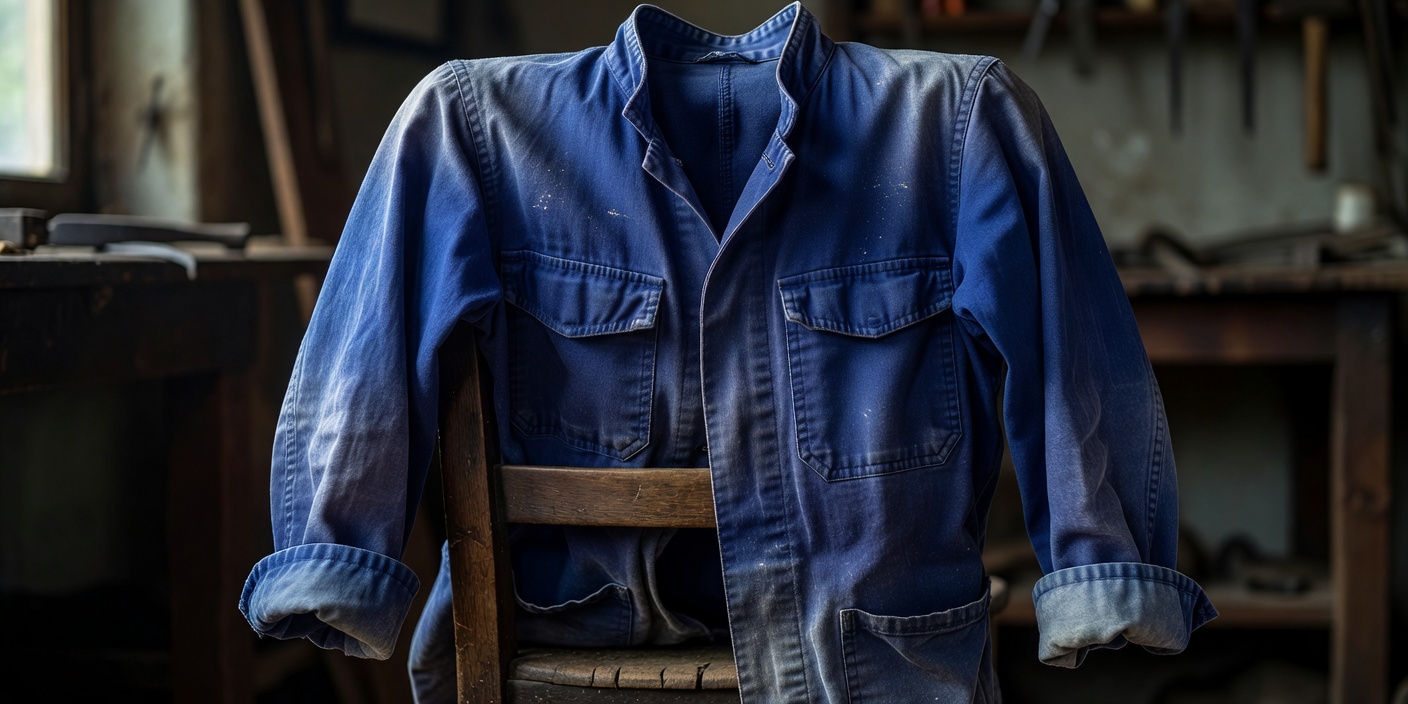
The Chemistry of French Moleskin
Contrary to its literal English translation, moleskin contains no animal pelt. It is a heavyweight cotton satin weave with an exceptionally high number of picks per inch. Once woven on narrow shuttle looms, the face of the cloth is sheared repeatedly with rotating spiral blades, followed by heavy wire brushing.
This process creates a dense, velvety nap on the outside while maintaining an impenetrable, tightly bound grid underneath. In the 1800s in Lyon and the Loire region, this density was essential: when molten metal sparks flew from the foundry furnace, they would bounce harmlessly off the brushed fibers rather than igniting the garment.
Anatomy of the Archetypal Chore Jacket
Unlike English tailoring which utilizes structured chest padding, canvas roping, and shoulder pads, the traditional French chore coat is strictly unconstructed. It relies on geometric pattern cutting:
Master Blueprint Specifications
- Pockets: 3 exterior patch pockets, 1 interior ticket welt
- Collar: Rounded French work collar without stand
- Buttons: Genuine Corozo nut or stamped lacquered metal
- Seams: Double-needle flat-felled chain stitching
- Weight: 380 g/m² to 440 g/m² 100% Cotton
- Dye: Vat-dyed Hydron Blue or Natural Indigo
Why Modern Fast Fashion Cannot Replicate It
Modern high-street versions use lightweight open-end rotor-spun yarns and artificial chemical stone-washing to simulate age. A genuine French heirloom from heritage mills in Villefranche or Beaujolais uses combed ring-spun Egyptian cotton, sanforized to prevent shrinkage, which starts extraordinarily stiff and requires several seasons of actual body heat and wear to break in.